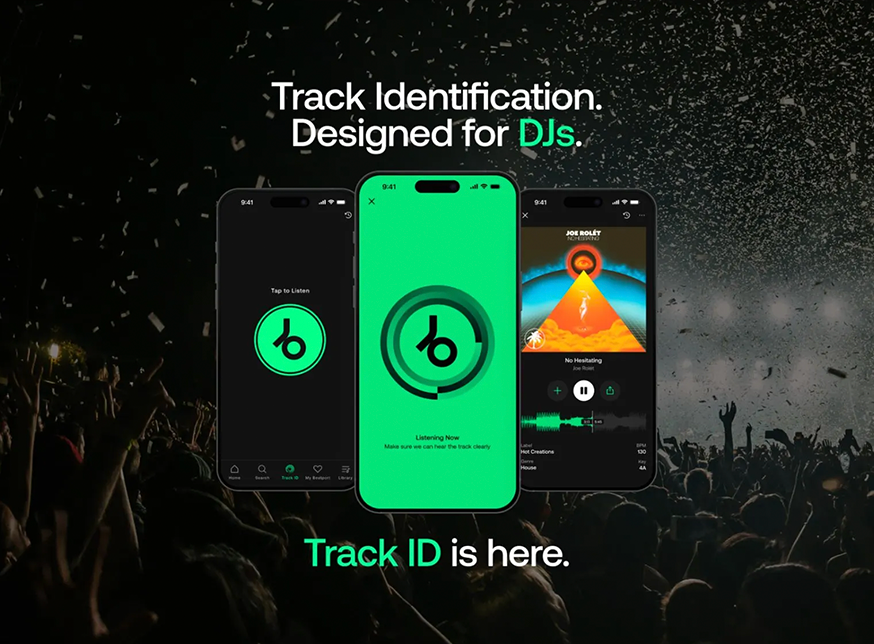
For anyone who has ever stood on a dancefloor at 2am, phone held aloft, watching Shazam spin hopelessly while a DJ drops something unreleased or buried deep in a white-label crate, Beatport’s new Track ID feature arrives with the weight of a long-overdue apology. The platform, which remains the dominant retail outlet for house, techno, and the broader underground, has launched its own music-identification tool built directly into its ecosystem.
The move positions Beatport as more than a shop. Apple’s Shazam has owned the music-identification space almost without challenge for years, but Shazam was never built for the underground. It struggles with unreleased edits, promos that never hit streaming, and the kind of catalogue-deep cuts that define a serious DJ set. A tool that lives inside Beatport’s infrastructure, with access to its own catalogue of electronic music releases, has an obvious structural advantage in those exact situations where Shazam falls flat.
The feature mirrors Shazam’s core mechanic, listening to audio and returning a match, but the logic behind building it natively into Beatport is pointed. When a Track ID resolves, a buyer is already inside the storefront. The friction between discovery and purchase collapses entirely. That is a commercial calculation as much as a community service, but the two things are not in conflict here. Getting people to the record they want to buy faster is genuinely useful.
The underground has always had a Track ID problem. Forum threads, Reddit posts, and dedicated Facebook groups have existed for years purely to crowdsource identifications that no automated tool could crack. Boiler Room comment sections fill with desperate timestamp requests after every set. If Beatport’s tool can dent that problem even partially, by matching against its own deep catalogue of releases, it addresses something the community has been managing manually and imperfectly for a long time.
Whether the feature can extend its reach beyond the Beatport catalogue to cover promos, unreleased material, and the kind of locked-away edits that circulate only on USB drives is the real question. That is the frontier where the identification problem actually lives, and where no tool has yet managed to go. What Beatport has built is a meaningful start. The rooms have been waiting for this longer than the platform probably realises.